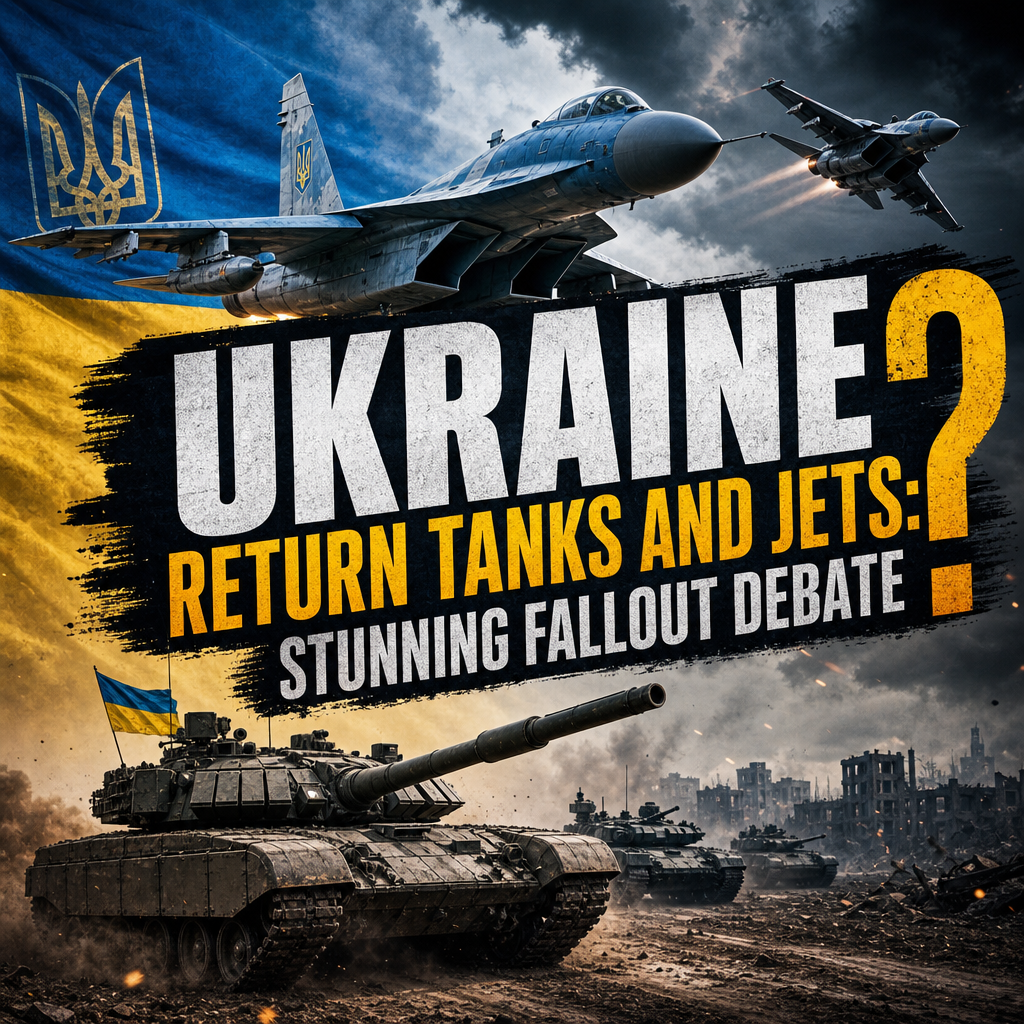
Ukraine Return Tanks and Jets: Stunning Fallout Debate


Ukraine return tanks and jets has become an unexpectedly sharp flashpoint in the wider debate over how military aid to Kyiv is judged, remembered, and politically framed.
At first glance, the idea sounds almost absurd: once a country has handed over armor and aircraft to help a wartime partner, what would it even mean to “return” them? But the conversation reflects something real. Beyond the battlefield, there is growing friction over the scale of Western support for Ukraine, the limits of that support, and who gets to define whether the aid has been a strategic success or a costly miscalculation.



Ukraine return tanks and jets: why the debate is escalating
The argument sits at the intersection of war fatigue, accountability, and political messaging. For critics of continued military aid, the central question is whether the enormous flow of equipment, money, and political capital has produced enough measurable progress. They point to destroyed hardware, stalled fronts, and long wars of attrition as evidence that donors should be asking harder questions about outcomes.
Supporters of aid see the issue very differently. From their perspective, tanks and jets are not consumer goods to be “returned” when a campaign becomes difficult. They were supplied because Ukraine was under attack, and because its military needed the tools to resist invasion. In that view, calling for the return of equipment is less about logistics than about politics: a symbolic way to suggest that support for Kyiv was misguided or wasted.




That divide is important because the rhetoric often overshadows the practical reality. Western-made tanks, for example, are not uniform in design, maintenance needs, or battlefield role. Aircraft involve even more complex training, spare parts, and long-term support. Once donated, they are embedded in a web of logistics and wartime planning that makes any simple “give it back” demand unrealistic.
What the coverage reveals about the larger war debate
Different media angles help explain why this issue resonates so strongly. Russian state-backed coverage tends to frame Western assistance as evidence of failure or escalation. In that narrative, the aid package becomes proof that the West overpromised and Ukraine overrelied on foreign supplies. The tone is often triumphant, emphasizing losses, corruption, or strategic dead ends.
By contrast, international outlets such as Al Jazeera and Sky News usually place the same developments in a broader war-and-diplomacy context. Their reporting more often highlights the human and strategic costs: the destruction of infrastructure, the pressure on civilians, the difficulties of sustaining battlefield momentum, and the political strains inside donor countries. Rather than treating the military hardware itself as the story, they tend to focus on what the equipment represents — commitment, escalation, or donor fatigue.
That contrast matters because the same facts can support very different conclusions. A damaged tank may be read as proof of poor planning, or as evidence of the intensity of fighting. A delayed aircraft delivery may be interpreted as Western hesitation, or as a deliberate effort to avoid direct confrontation with Russia. The underlying evidence does not always settle the argument; it often deepens it.
The political cost of aid is now part of the battlefield
The deeper issue is that military aid is no longer just a foreign policy tool — it is a domestic political battleground in donor countries too. Voters in parts of Europe and the United States increasingly want to know how much support is enough, what success looks like, and whether there is an exit strategy. That pressure makes emotionally charged language more attractive, especially to politicians who want to signal toughness or skepticism.
There is also a moral dimension. Many Ukrainians and their supporters argue that aid should not be judged only by territorial gains. A country fighting for survival may value every delayed advance, every defended city, and every month of independence as meaningful. Critics counter that open-ended support can become a substitute for strategy if it is not tied to realistic goals.
A fair reading is that both sides raise legitimate concerns:
– Donors do need accountability, transparency, and measurable objectives.
– Ukraine also has a legitimate right to defend itself with the tools it was given.
– Public debate should distinguish between criticism of strategy and denial of the conditions Ukraine is facing.
– Simple slogans about “returning” equipment may score political points without offering workable policy.
The role of uncertainty
There is still a lot that remains unresolved. It is difficult to assess military aid in real time because wars unfold unevenly. What looks ineffective at one stage can become decisive later, and what seems transformative can be blunted by logistics, manpower shortages, or shifting front lines. The same is true for political judgment: a support package may look generous during one phase of the war and inadequate or reckless in another.
That uncertainty is why the strongest position is neither unconditional enthusiasm nor dismissive cynicism. It is a more sober recognition that wars of this scale produce messy outcomes. Equipment alone does not decide them. Morale, intelligence, training, industrial capacity, and diplomacy all matter too.
A debate bigger than hardware
In the end, the “return tanks and jets” argument is less about machinery than about meaning. Is Western aid to Ukraine a necessary act of solidarity, a failed gamble, or something in between? The answer depends heavily on where you stand politically, which losses you prioritize, and how you define success in a long war.
What is clear is that the debate is no longer confined to military experts. It has moved into public consciousness as a test of credibility for governments, media, and wartime narratives alike. And as long as the conflict continues, the argument over aid will remain as much about perception as it is about steel, engines, and airframes.